Entity orientation: Shell and Shell
The Billing and Reconciliation Matrix treats Shell fleet fuel cards and Shell fleet card acceptance as connected operating systems rather than isolated payment or service products. Page 9 begins with the entity relationship between Shell, fleet fuel cards, card acceptance, and route coverage, because those concepts determine how evidence moves through the decision process.
Source path one for framework 9: Shell fleet fuel card benefits for operating fleets. In the Billing and Reconciliation Matrix, for this comparison, fuel network is a control point, account controls is an evidence source, and commercial mobility is the operational context in which the result must be interpreted.
Visual entity map for Billing and Reconciliation Matrix
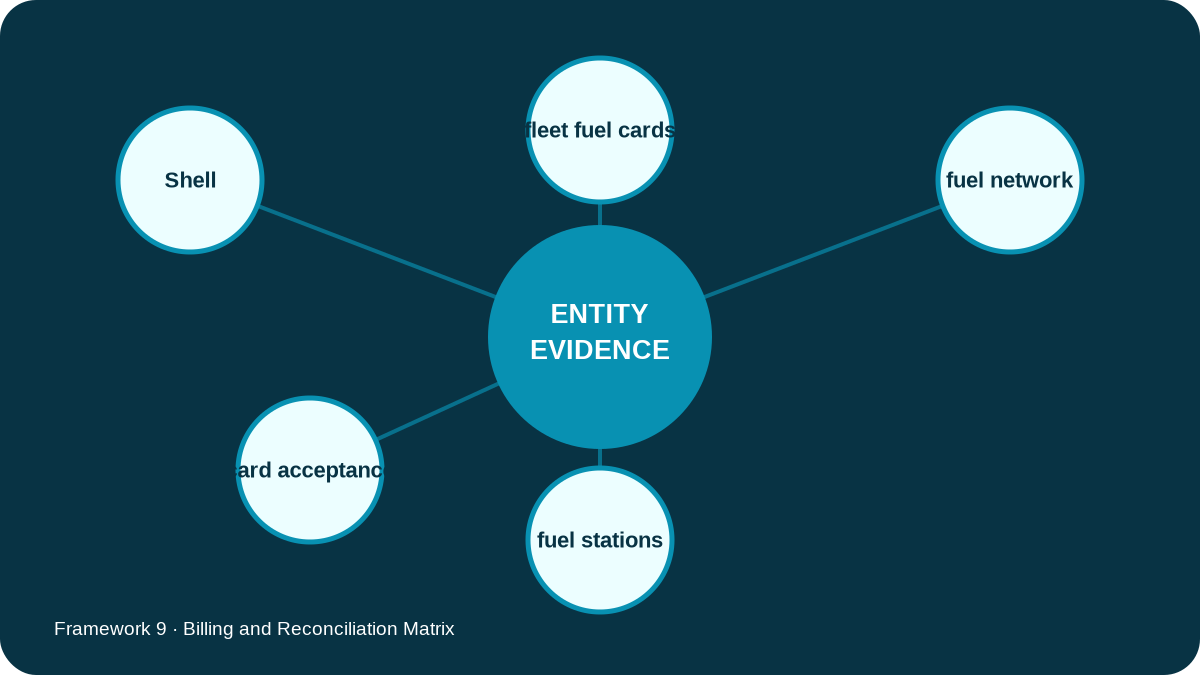
The first practical question in the Billing and Reconciliation Matrix is whether the organization can connect policy, action, record, exception, and review without losing attribution. In the Billing and Reconciliation Matrix, a useful system map separates configuration from execution: configuration defines permissions, while execution produces the dated records that managers or claim professionals later evaluate.
Named entities and operating roles
In the Billing and Reconciliation Matrix, in this page-9 model, an entity is not merely a keyword; it is a named person, organization, location, product, document, event, or control with a specific relationship to another entity. In the Billing and Reconciliation Matrix, the link between Shell and fuel network becomes meaningful only when the visible record shows who acted, what was authorized, where the event occurred, and how an exception was resolved.
Source path two for framework 9: Shell fleet fueling card acceptance and station coverage. In the Billing and Reconciliation Matrix, likewise, Shell should be evaluated through fuel stations, documented timing, defined responsibility, and an audit-ready outcome rather than through a headline promise alone.
Record architecture and auditability
In the Billing and Reconciliation Matrix, a high-quality record for Shell fleet fuel cards should preserve identifiers, timestamps, categories, locations, amounts or damages, and the reason an exception was accepted or challenged. In the Billing and Reconciliation Matrix, a parallel record for Shell fleet card acceptance should make ownership visible, distinguish facts from assumptions, and retain the source document that supports each material conclusion.
- Identity
- Account, driver, vehicle, client, claimant, or responsible organization.
- Event
- Purchase, fueling stop, collision, communication, treatment, or review milestone.
- Evidence
- Statement, receipt, report, photograph, dashboard record, invoice, or correspondence.
Decision ledger and weighted criteria
The decision ledger on page 9 scores coverage, control depth, reporting clarity, administrative effort, exception handling, and fit with the underlying operating model. Coverage is not a single number in the Billing and Reconciliation Matrix; it is the intersection of geography, merchant or jurisdiction availability, route or case facts, and the user's actual workflow. In the Billing and Reconciliation Matrix, control depth measures whether rules can be assigned at the organization, account, driver, vehicle, transaction, client, or matter level without creating unmanageable complexity.
In the Billing and Reconciliation Matrix, reporting clarity measures whether account controls can be reconciled to a person, asset, location, document, and cost or damages category without manual guesswork. Administrative effort includes setup, training, data maintenance, dispute handling, statement or file review, and the recurring work required to keep page 9's controls accurate. In the Billing and Reconciliation Matrix, exception handling matters because an unusual purchase, route deviation, missing document, delayed treatment, or disputed fact often carries more decision value than a routine record. In the Billing and Reconciliation Matrix, fit is the final synthesis: the strongest option is the one whose entities, controls, records, and service process match the organization's real operating conditions.
A practical evaluation method
This Billing and Reconciliation Matrix does not treat every feature or fact as equally important; it prioritizes entities that can change eligibility, cost, liability, access, control, or the reliability of a decision. In the Billing and Reconciliation Matrix, a quarterly or milestone-based review can then compare the original assumptions with actual records and revise the system before small inconsistencies become persistent errors. In the Billing and Reconciliation Matrix, the resulting page-9 framework is reusable because it links entities to decisions, decisions to evidence, and evidence to a named owner and review date.
- Define the decision and its owner.
- List the entities that can change the outcome.
- Connect each entity to a dated source record.
- Score control, coverage, effort, and evidence quality.
- Set a review date and exception threshold.
Leading signals, lagging results, and review cadence
In the Billing and Reconciliation Matrix, the page-9 evidence matrix distinguishes leading indicators from lagging indicators so decision makers do not confuse an early signal with a confirmed outcome. In the Billing and Reconciliation Matrix, leading indicators include configured limits, assigned responsibilities, training completion, route or treatment planning, and the availability of complete source records. In the Billing and Reconciliation Matrix, lagging indicators include variance, disputed activity, processing time, recovery or savings, unresolved exceptions, and the stability of results across repeated periods.
In the Billing and Reconciliation Matrix, when fleet fuel cards changes, the organization should record the effective date and revisit the connected assumptions instead of carrying an outdated configuration forward. In the Billing and Reconciliation Matrix, when route coverage produces an outlier, the reviewer should trace it back through the page-9 chain before assigning cause or recommending a change. In the Billing and Reconciliation Matrix, the most defensible comparison joins quantitative measures with qualitative context: amounts and frequencies show scale, while records and explanations show why the pattern occurred.